
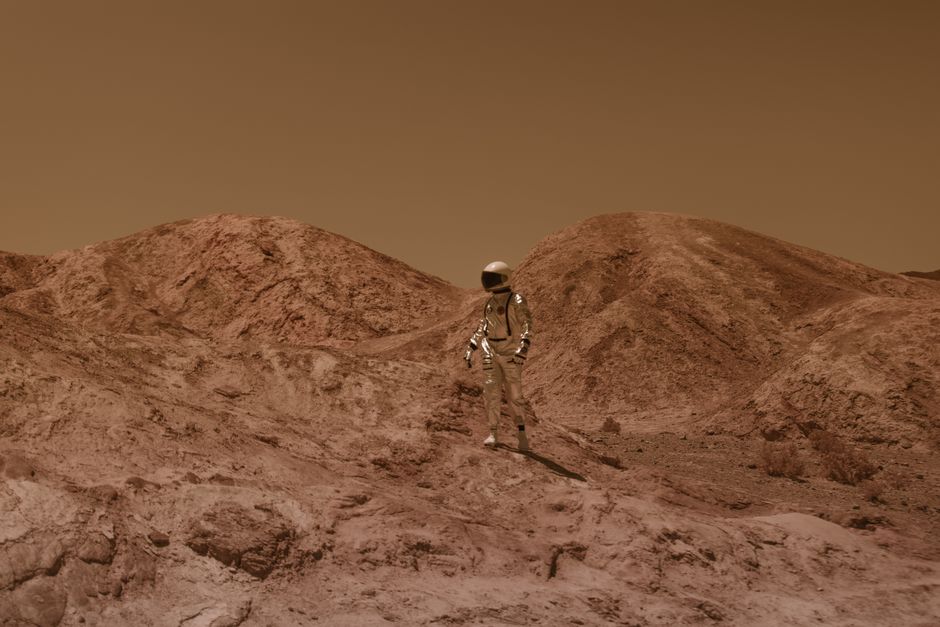
A photograph captured by NASA’s Mars exploration equipment has sparked widespread attention after internet users identified what appears to be a human-shaped figure on the Martian surface, reigniting debates about unusual formations on the Red Planet.
The Image That Started The Discussion
The photograph, taken by NASA’s Mars observation technology, shows a rock formation that bears a striking resemblance to a walking human figure. The image has circulated widely online, with observers noting the formation’s head, torso, and leg-like structures that appear remarkably similar to a person in mid-stride across the rocky Martian landscape.
Social media users quickly shared the image, with many expressing amazement at the human-like appearance of the formation. The photograph joins a long history of Mars images that have captured public imagination, from the famous Face on Mars to various other rock formations that resemble familiar objects or beings.
Scientific Explanation Behind The Phenomenon
Scientists attribute such sightings to pareidolia, a psychological phenomenon where the human brain interprets random patterns as familiar shapes, particularly faces and human forms. This natural tendency helped our ancestors quickly identify threats and allies, but now causes people to see meaningful images in clouds, toast, and apparently, Martian rocks.
Mars exploration has produced numerous examples of pareidolia over the decades. The harsh Martian environment creates countless rock formations through wind erosion, ancient water flow, and geological processes spanning billions of years. These natural forces occasionally produce shapes that trigger human pattern recognition instincts, leading to interpretations of artificial or biological origins.
Mars Exploration Continues
NASA maintains active exploration missions on Mars, with rovers and orbiters continuously photographing the planet’s surface. These missions serve legitimate scientific purposes, studying Martian geology, searching for signs of ancient microbial life, and preparing for potential future human exploration. While unusual rock formations generate public interest, the actual scientific discoveries about Mars’ past water presence and geological history represent the missions’ true achievements. The space agency regularly addresses public questions about unusual images, emphasizing scientific explanations while appreciating the public engagement such discoveries generate.
If the image above is the one in question then the questioners are all idiots.
You have to ask, Where and When was the main Photo displayed in this article taken? Like this was Supplied by NASA? Seriously? The Video supplied by NASA, the Background Color of the Mountains Does NOT Match the Still Photo shown in the Article. Inquiring minds want to know.
As my Yiddish Martian cousin would say…
OYO VEY!!!
I agree with everyone; that is so fake. The the people responsible for this must think that we are so stupid.
I must be blind or something, because I don’t see anything.
You’re not blind. I have excellent eyesight and I didn’t see anything either.
Yea, I saw nothing. And the first fake news, it seriously resembled a robot. Imagine that@
I was born at Night but “NOT” last night! When NASA recently stated that a spacecraft crashed on the Moon, I turned to my wife and said, “I hope it didn’t knock down the Flagpole”!
I’ve looked at the video numerous times, and I don’t see a thing. I too must be blind, because I can’t imagine what they are referring to!
As long as there are humans we want to see life and if it is beyond our Earth, all the better