
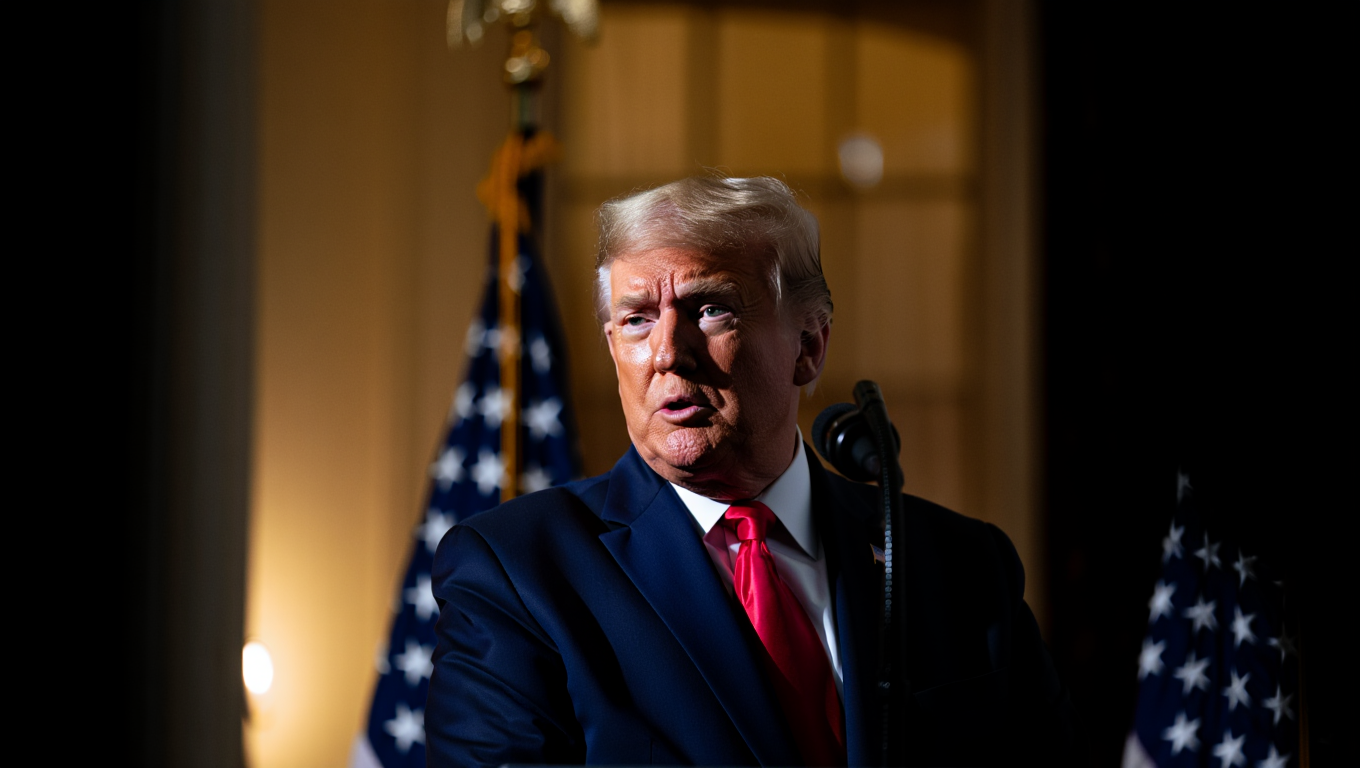
President Donald Trump issued a statement Wednesday regarding a deadly confrontation in Minneapolis between Immigration and Customs Enforcement officers and protesters, which resulted in the fatal shooting of a female driver who authorities say attempted to strike federal agents with her vehicle.
The incident occurred during what the Department of Homeland Security described as “targeted operations” by ICE personnel in the Minneapolis area. According to federal officials, the situation escalated when protesters began interfering with the enforcement activities, culminating in what DHS characterized as an attempted vehicular assault on law enforcement officers.
Presidential Response and Official Statement
In a detailed post on his Truth Social platform, President Trump described viewing video footage of the confrontation and offered his assessment of the events. The president characterized the driver’s actions as deliberate and aggressive, stating that she had “violently, willfully, and viciously” struck an ICE officer before being shot by federal agents.
She gets ordered out of her car.
She refuses.
She backs up.
Then she drives forward—straight into an ICE agent.
The agent draws his gun *only* when her vehicle starts moving toward his body.
Self-defense.
Case closed. pic.twitter.com/caBBHteXVd
— Officer Lew (@officer_Lew) January 7, 2026
Trump’s statement emphasized his view that the shooting constituted an act of self-defense by the federal officer, who he said appeared to be in immediate danger of being run over by the vehicle. The president noted that despite the severity of the incident, the ICE agent survived and is currently receiving medical treatment at a hospital facility.
“Based on the attached clip, it is hard to believe he is alive but is now recovering in the hospital,” Trump wrote, referencing video evidence that he said supported the officer’s decision to use deadly force in the situation.
Department of Homeland Security Classification
Federal authorities have taken the unusual step of classifying the driver’s actions as domestic terrorism. The Department of Homeland Security issued a statement explaining that the woman had “weaponized her vehicle” in what they described as a deliberate attempt to kill federal law enforcement officers.
The DHS statement outlined the sequence of events, indicating that ICE officers were conducting routine enforcement operations when they encountered resistance from protesters. According to the federal agency, the situation deteriorated when demonstrators began actively obstructing the officers’ work, leading to the confrontation that resulted in the fatal shooting.
Rep. Hakeem Jeffries (D-NY) blatantly lies and says there’s no evidence that the woman in Minneapolis did anything wrong.
You know, except for the video of her driving her car right into ICE officers.pic.twitter.com/92AeacYMVF
— Paul A. Szypula 🇺🇸 (@Bubblebathgirl) January 7, 2026
“An ICE officer, fearing for his life, the lives of his fellow law enforcement and the safety of the public, fired defensive shots,” the DHS statement read, providing the official justification for the use of lethal force during the encounter.
Video Evidence and Physical Documentation
Multiple video recordings of the incident have surfaced on social media platforms, providing different angles of the confrontation between federal agents and the driver. The footage appears to show the moments leading up to and during the shooting, though the quality and perspective of the recordings vary significantly.
Physical evidence at the scene includes visible damage to the driver’s vehicle, with a bullet hole documented in the front windshield. Federal investigators point to this damage as supporting evidence that the ICE agent was positioned directly in the path of the oncoming vehicle when the decision was made to use deadly force.
The presence of this ballistic evidence has become a key component in the official narrative presented by federal authorities, as it appears to corroborate claims that the officer was in immediate physical danger at the time of the shooting.
You’ve got so called protesters grabbing for officers weapons.
These are criminals not protesters.
Make no mistake it’s really dangerous for law enforcement in Minneapolis.
— 0HOUR1 (@0hour1) January 7, 2026
Political Context and Broader Implications
President Trump used the incident to reinforce his administration’s broader messaging about threats facing federal law enforcement officers. In his statement, he attributed the confrontation to what he termed “Radical Left” opposition to immigration enforcement activities.
The president argued that such incidents are becoming increasingly common due to organized resistance to federal immigration operations. He called for increased support and protection for ICE agents and other law enforcement personnel, who he said face daily threats while attempting to carry out their duties.
“The reason these incidents are happening is that the Radical Left is threatening, assaulting, and targeting our Law Enforcement Officers and ICE Agents on a daily basis,” Trump stated, framing the Minneapolis incident within a larger pattern of anti-law enforcement sentiment.
Investigation and Review Process
Federal authorities have indicated that a comprehensive investigation into the shooting is currently underway. The review process will examine all available evidence, including video recordings, witness statements, and physical evidence from the scene.
Standard protocol for officer-involved shootings typically includes multiple levels of review, encompassing both administrative and criminal investigations. The domestic terrorism classification adds a layer of complexity to the case, potentially involving federal prosecutors and specialized counterterrorism units.
The injured ICE officer’s medical condition will likely be documented as part of the investigation, providing additional evidence regarding the severity of the vehicular assault and the immediate threat faced by federal personnel during the incident.
Community Response and Public Safety Concerns
The Minneapolis incident highlights ongoing tensions between federal immigration enforcement operations and local community resistance. Such confrontations have become increasingly common in jurisdictions where local officials and residents oppose aggressive immigration enforcement tactics.
Public safety officials must now balance the need for effective law enforcement with concerns about escalating confrontations between federal agents and community members. The classification of the driver’s actions as domestic terrorism may influence how similar future incidents are handled and prosecuted.
The case also raises questions about protest tactics and the boundaries between civil disobedience and criminal activity. The distinction between lawful demonstration and violent resistance becomes particularly significant when federal agents are involved in enforcement operations.
Legal and Policy Ramifications
The domestic terrorism classification could have far-reaching implications for how federal authorities approach immigration enforcement in areas with significant community resistance. It may also influence prosecutorial decisions in similar cases and affect the resources allocated to protecting federal agents during operations.
Legal experts will likely scrutinize the justification for the deadly force used in this case, examining whether the officer’s actions met established standards for self-defense in law enforcement contexts. The availability of video evidence from multiple angles may provide unusual clarity in determining the appropriateness of the officer’s response.
The incident occurs against the backdrop of ongoing national debates about immigration policy, law enforcement tactics, and the appropriate limits of federal authority in local communities. These broader policy discussions may influence public perception of the Minneapolis shooting and similar future incidents.