
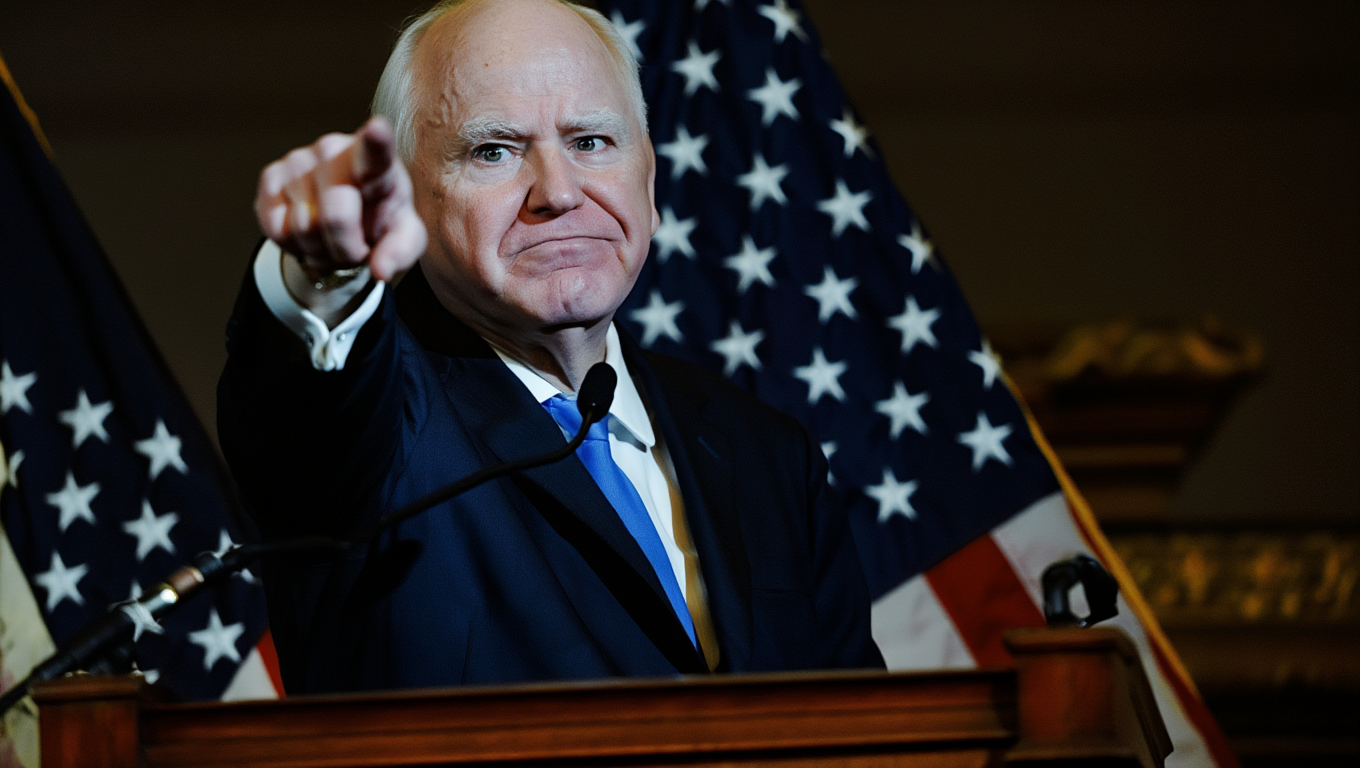
In a stunning display of political defiance that has left many Minnesotans scratching their heads, Governor Tim Walz delivered a fiery rebuke to critics calling for his resignation, declaring emphatically that he would step down “over my dead body.” The embattled Democrat’s outburst came just one day after he shocked the political establishment by announcing he would not seek a third term as governor in 2026.
For a politician who once seemed destined for higher office—having served as Kamala Harris’s running mate in the failed 2024 presidential campaign—Walz’s dramatic fall from grace represents a cautionary tale about the consequences of failed leadership and misplaced priorities. His refusal to accept responsibility for what federal prosecutors describe as potentially $18 billion in fraud that occurred under his watch reveals a troubling pattern of deflection that has become all too common among progressive politicians.
The governor’s emotional response to legitimate criticism speaks volumes about his character and fitness for office. Rather than demonstrating the humility and accountability that Minnesotans deserve, Walz chose to lash out at Republicans and even attempt to redirect blame toward President Trump. This kind of finger-pointing might play well with his progressive base, but it does nothing to address the real victims of this scandal—the vulnerable Minnesotans who were deprived of resources that were instead stolen by criminals.
A Fraud Crisis That Demands Real Leadership
The scope of the fraud that flourished under Walz’s administration is breathtaking in its audacity and devastating in its impact. Federal investigators have uncovered a sprawling network of corruption involving housing assistance, food aid programs, and daycare services that may have cost taxpayers up to $18 billion. This isn’t just a matter of a few bad actors slipping through the cracks—this represents a systemic failure of oversight and governance that strikes at the heart of public trust.
First Assistant U.S. Attorney Joe Thompson’s assessment of the potential $18 billion loss should serve as a wake-up call to every American about the importance of proper stewardship of taxpayer dollars. When government programs designed to help our most vulnerable citizens become vehicles for massive fraud, it not only robs those truly in need but also undermines the social contract between government and the governed.
Only parasite Gavin Newscum could say Tim Walz is a man of integrity with a straight face. Vultures of a feather may stick together, but Grifter Gavin isn’t doing his laughable presidential campaign any favors giving a friendly reach around tug to a guy headed for life in prison. pic.twitter.com/ezv2kHwUbV
— James Woods (@RealJamesWoods) January 6, 2026
What makes this situation particularly galling is how preventable it appears to have been. Republican lawmakers who called for Walz’s resignation noted that “red flags were everywhere” and that “year after year the fraud kept growing, and year after year, nothing changed.” This suggests a pattern of willful negligence or, at best, incompetence that should disqualify any public official from continued service.
The Politics of Deflection
Perhaps most telling about Walz’s character is his immediate resort to racial and partisan rhetoric when confronted with legitimate criticism. His claim that Republicans “want to tell you everybody with brown skin is stealing money” is not only inflammatory but also represents exactly the kind of divisive politics that prevents real solutions to serious problems.
This deflection strategy is particularly offensive because it attempts to shield actual criminals from accountability by wrapping their crimes in the language of civil rights. The victims of this fraud scheme aren’t Republicans looking to score political points—they’re the legitimate recipients of government assistance who were denied help because resources were diverted to criminals. By playing the race card, Walz is essentially arguing that proper oversight of government programs is somehow discriminatory.
The governor’s attempt to shift blame to President Trump is equally disingenuous. The fraud that occurred in Minnesota happened under Walz’s watch, with his administration’s oversight, and through programs under his control. No amount of political theater can change these basic facts.
https://twitter.com/EricLDaugh/status/2008605268322701379
A Pattern of Progressive Governance Failures
Walz’s handling of this crisis fits into a broader pattern of progressive governance that prioritizes good intentions over effective results. Too often, liberal politicians seem to believe that caring deeply about an issue is sufficient, even when their policies fail to deliver for the people they claim to serve.
The Minnesota fraud scandal represents the logical endpoint of this approach—a system so focused on appearing compassionate that it loses sight of basic accountability measures. When oversight is viewed as somehow contrary to progressive values, the inevitable result is the kind of massive fraud that has embarrassed Minnesota and betrayed the trust of its citizens.
This isn’t just about one governor or one state. It’s about a fundamental approach to governance that puts political posturing ahead of practical results. Americans across the country are watching this scandal unfold and asking themselves whether their own state and local officials are providing proper oversight of taxpayer-funded programs.
The GOP Response Shows Real Leadership
In contrast to Walz’s theatrical outbursts, the Republican response to this crisis has been measured and focused on accountability. The GOP-led House Oversight Committee’s decision to investigate this fraud represents exactly the kind of responsible governance that Americans expect from their elected officials.
The bipartisan group of Minnesota Republican lawmakers who called for Walz’s resignation demonstrated real courage in putting principle ahead of political convenience. Their statement, acknowledging that “we do not make a call like this lightly” and emphasizing that “the office of the governor deserves respect,” shows a level of institutional respect that has been notably absent from Walz’s own response.
These Republicans understand something that Walz apparently doesn’t—that true leadership sometimes requires making difficult decisions and accepting responsibility for failures. Their willingness to speak truth to power, even when it’s politically uncomfortable, represents the kind of principled governance that Minnesota needs.
What This Means for America
The implications of the Minnesota fraud scandal extend far beyond the borders of the North Star State. This crisis serves as a test case for how seriously we as Americans take the stewardship of public resources and the accountability of our elected officials.
If Walz is allowed to remain in office despite this massive failure of oversight, it sends a message to politicians across the country that there are no real consequences for incompetence or negligence. It tells future office-seekers that as long as they can deflect blame and play political games, they can survive even the most egregious failures of leadership.
Conversely, holding Walz accountable would demonstrate that American voters still expect basic competence from their elected officials. It would show that good intentions are not sufficient when they are not backed up by effective governance and proper oversight.
The choice facing Minnesota—and by extension, America—is clear. We can either accept this kind of failed leadership as the new normal or demand better from those who seek to serve in public office. The decision we make will echo through our political system for years to come.
Let him go to Somalia with all the people they are deporting (hopefully). After the ICE incident today, he had the gall to say the agent was “a rogue ICE agent.” How did he ever get to the position he’s in?