
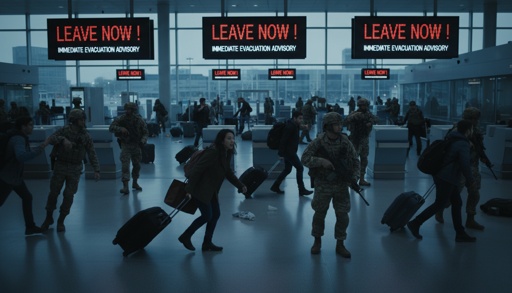
One woman’s stolen suitcase and a split-second burst of pepper spray at Heathrow exposed how fragile your safety really is in the places you assume are most protected.
How A Routine Morning Turned Into A Chemical Chaos Zone
Sunday commuters expected gridlock and overpriced coffee, not burning eyes and armed officers storming a car park. At 8:11 a.m., in the multi-storey at Terminal 3, four men cornered a woman in a lift and tore away her suitcase. One of them raised a canister and sprayed what police believe was pepper spray toward her. Still, the confined space and poor ventilation turned a targeted robbery into a cloud of chemical distress for 21 people, among them a three-year-old girl.
Five victims needed hospital treatment, while another sixteen were treated at the scene for breathing difficulties and eye irritation. The London Ambulance Service fought symptoms, not ideology; police made clear this was a crime, not terrorism.
Yet for travelers choking and crying in the car park, those technical distinctions meant little. One 31-year-old suspect was arrested on suspicion of assault as three others vanished into the wider road network, triggering a search across west London.
Why A Car Park Lift Became The Weakest Link In Airport Security
Terminal 33’s multi-storey car park sits directly opposite the check-in hall, a hinge point where families, business travelers, and luggage all converge in tight spaces.
This is where today’s security paradox shows itself: airside, passengers walk through scanners, liquid limits, and ID checks; outside, in the car parks and forecourts, anybody can linger with a can of pepper spray or worse. Heathrow’s layout pushes valuables and vulnerable people into areas with the lightest-touch security and the slowest protective response.
That structural weakness is not theoretical. Heathrow’s history is a ledger of what happens when criminals and extremists test the gray zones. The 1974 IRA bomb in a Terminal 1 car park injured two people and proved that vehicles and parking structures were easy targets.
The 1983 Brink’s-Mat robbery near Heathrow saw 6,800 gold bars vanish from a supposedly secure vault. Subsequent multimillion-pound thefts from aircraft and warehouses in 2002 and the foiled 2004 bullion raid confirmed that organized crime views Heathrow as a profit center in disguise as a transport hub.
Patterns, Not Flukes: Pepper Spray, CS Gas, And A Culture Gap
The December pepper-spray attack did not arrive in a vacuum. Just three months earlier, Terminal 4 was evacuated after a passenger discharged a CS gas canister, disrupting flights and panicking crowds. Two chemical agent incidents in public-facing areas in one quarter should worry anyone who values basic competence in critical infrastructure. While police underline that the Heathrow pepper-spray attack is “not terrorism-related,” criminals have learned a blunt lesson: cheap crowd-control weapons turn crowded facilities into chaos amplifiers.
The pattern stretches beyond physical attacks. Heathrow’s security culture has already been questioned over data handling. A lost, unencrypted USB stick contained details of the Queen’s travel routes and personal data on security staff.
At the same time, only 2 percent of 6,500 workers had received data protection training. Suppose an organization cannot enforce basic digital hygiene. In that case, Americans who prize responsibility and accountability have every reason to ask hard questions about how rigorously it guards its car parks, lifts, and perimeters.
Consequences For Travelers, Communities, And Conservative Common Sense
The immediate fallout was visible miles from Terminal 3. Police closed the M4 Spur Road, halted trains and buses into Heathrow, and turned a localized attack into region-wide gridlock. Families missed flights, workers lost wages, and businesses ate the cost of delays and cancellations. For all the rhetoric about “resilience,” a single can of spray and a stolen suitcase were enough to choke one of Europe’s primary economic arteries for hours.
Supporters of limited but effective government will see a familiar pattern of failure. Taxpayers fund vast security infrastructure, yet the most basic vulnerabilities—poorly monitored car parks, unsecured perimeters, and inconsistent training—continue to produce crises.
When 21 innocent people, including a toddler, can be injured in seconds because four criminals faced little deterrence in a supposedly controlled environment, calls for targeted, measurable, and enforced security upgrades are not “overreaction.” They are common sense.
What Must Change Before The Next Crowd Becomes Collateral
Police continue to review CCTV, track the three outstanding suspects, and reassure the public that travel is safe. That is necessary but insufficient. The real test will be whether Heathrow and peer airports treat this as a pivot point rather than an unfortunate headline. Car parks and forecourts need tighter surveillance, better lighting, faster-acting alarms, and visible patrols proportionate to the volume of people and value of property they funnel every day.
For conservatives who value both liberty and order, the path forward lies in targeted competence, not sprawling bureaucracy. Harden the genuine weak spots, measure outcomes, and hold operators to account when repeat patterns—like chemical agents in terminals or gross data negligence—resurface. Heathrow has been a magnet for terrorists, thieves, and now violent opportunists for decades. Until its leaders treat the car park lift with the same seriousness as the boarding gate, travelers will keep learning the hard way where the real risks live.
Sources:
Heathrow pepper spray incident – The Independent
Five times airports were involved in cyberattacks and data breaches
European airports cyber incident and critical infrastructure – WEF
Heathrow, Brussels, Berlin airport cyber attack delays – The Independent