
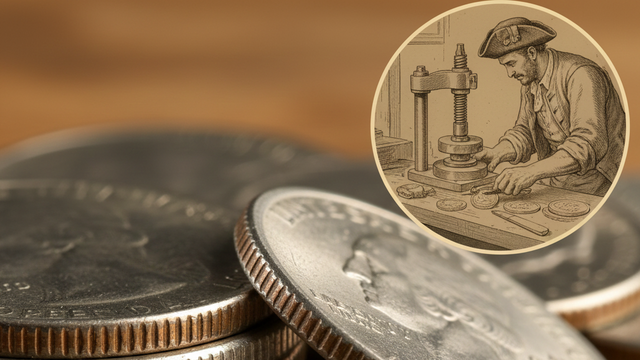
Take a close look at a modern U.S. dime or quarter. You’ll notice its circumference is lined with tiny, parallel ridges. This feature, known as reeding, is so common that most people rarely give it a second thought. Yet, these simple lines are not mere decoration; they represent a centuries-old technological defense against economic fraud, designed to preserve the integrity of national currency.
The story of the reeded edge is a compelling intersection of history, economics, and anti-counterfeiting innovation.
The Problem: The Peril of Clipping
In the 17th century, coins in Europe and the Americas were commonly minted from precious metals like gold and silver. A coin’s face value was directly linked to its weight and metal content. This made them vulnerable to a pervasive form of fraud known as clipping.
Clippers would stealthily shave small amounts of metal from the edges of numerous coins. They could then melt down the collected shavings to create new coins or sell the raw metal for profit. Widespread clipping severely reduced the actual value of currency in circulation, leading to economic instability and massive loss of public trust in the monetary system.
A clipped coin, having lost metal, was noticeably smaller or irregularly shaped, but in the chaos of daily transactions, this tampering was often overlooked. The solution needed to be simple, standardized, and immediately visible.
The Solution: Sir Isaac Newton’s Innovation
The pivotal moment in solving the clipping problem came in the late 1600s, spearheaded by Sir Isaac Newton. Already a renowned scientist, Newton served as the Warden, and later Master, of the Royal Mint in Great Britain. Newton took the rampant issue of clipping extremely seriously, viewing it as a direct threat to the nation’s financial stability.
Newton formally implemented and perfected the practice of minting coins with a textured, ridged edge. This reeding ensured that the full circumference of the coin was stamped with a distinctive pattern. If even the slightest amount of metal was scraped off, the break in the pattern would be immediately obvious to anyone inspecting the coin. This innovation shifted the burden of proof from relying on coin weight to visual inspection.
U.S. Adoption and Legacy
When the United States established its own coinage system, it adopted many of the proven European minting standards. The Coinage Act of 1792 mandated the production of precious metal coins, and the U.S. Mint consequently adopted reeded edges for those denominations that held inherent value—specifically silver and gold coins.
Today, even though U.S. coins are made of base metals and their value is no longer tied to their metallic content, the tradition persists. Reeded edges remain standard on the coins that were historically made of precious metals:
- Dime (historically silver)
- Quarter (historically silver)
- Half-Dollar (historically silver)
Conversely, lower-value coins like the penny and the nickel, which were never made of high-value metals that would make clipping profitable, continue to have smooth edges.
Modern Relevance: Beyond Anti-Fraud
While the original anti-clipping function is largely obsolete, reeded edges serve important modern purposes, particularly in the realm of accessibility.
- Tactile Identification: The ridges provide a tactile cue that helps visually impaired individuals differentiate between coins of similar size but different values (e.g., a nickel, which is smooth, and a quarter, which is reeded).
- Aesthetic and Legacy: Reeding maintains a historical connection to currency design and helps maintain a high standard of quality in minting.
- Machine Recognition: The distinct edges are easily recognized by coin-sorting machines, ensuring accuracy in vending and change-counting mechanisms.